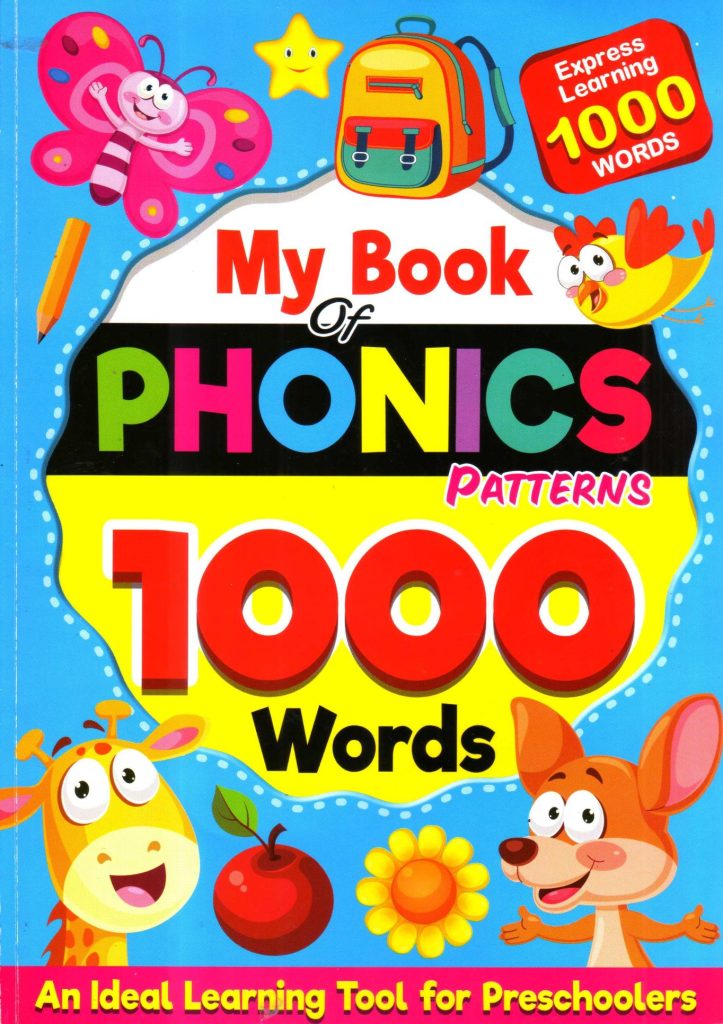
About This Book
My Book of Phonics Pattern 1000 Words is a children’s phonics-pattern book. The destination heading gives the exact title with the page’s download suffix; the file served there, ‘My Book of Phonics Pattern 1000 Words.pdf’, carries the exact title itself — the same volume under the filename the site serves it by. The book’s work is patterned decoding: a thousand words organised by their phonics families, so a beginning reader learns the pattern once and reads its whole family ever after.
English spelling has a public-relations problem: it is accused of chaos by everyone who has met ‘though’, ‘through’, and ‘tough’ in one afternoon. The accusation is half fair at the level of single words — and mostly false at the level of patterns. Within families, English behaves: the -ight words march together, the -ake words keep their shape, and the child who has internalised forty or fifty such families holds a skeleton key to thousands of words, including words no one has ever taught them. That is the pedagogical bet a pattern book makes, and the thousand in its title is the bet’s scale: not a thousand isolated memorizations, which no child would survive, but a thousand patterned encounters, each one cheaper than the last because the family resemblance does the remembering. There is a developmental courtesy in the method, too. Beginning readers drown in rules stated abstractly; patterns arrive as discoveries — the small shock of recognition when a new word turns out to be an old friend wearing a different first letter — and discovery is the one teaching force that requires no discipline to sustain, because the child pursues it voluntarily. A ‘my book’ of patterns is therefore sized to its owner: a personal arsenal, carried from the first sounded word to the fluent page, after which it is rightly outgrown — the only schoolbook whose success is measured by becoming unnecessary.
What Learners Will Practise
Families, Not Fragments
Children practise words in their spelling families, learning each pattern once and reading its relatives on sight. Recognition compounds: every new word that rhymes in print with a known one arrives half-learned.
Decoding until It Is Reflex
The book practises sounding-out across its thousand words until the effort drains away and the eyes simply read. Fluency is repetition that has finished its work, and the count is the rehearsal schedule.
Reading the Untaught
Readers practise the pattern method’s real prize: attacking unfamiliar words by their family resemblance. A child who can do this owns a strategy no word list can give, because it generates words.
Key Features
The pattern organisation is the feature: phonics taught as families rather than fragments. The thousand-word scale is the second — enough encounters for reflex — and the shelf fit the third, the child’s own book beside this list’s story-taught grammar and its ground-floor grammar. On this shelf it unlocks reading here.
Who This Book Is For
Beginning readers are its first audience, sounding out the world one family at a time. Parents form its second readership, hearing the homework and watching the reflex form. Early-years teachers make its third, arming whole classes against print.
How to Use This Book
Work family by family, aloud — patterns are heard before they are seen. Revisit earlier families inside later ones; the book’s repetitions are its method, not its padding. Stop the day decoding turns to reading, and let real books take over.
Related Books
The shelf’s story-taught grammar stands at English Grammar Through Stories, and its ground-floor grammar at Basic English Grammar Learners Book 1.